
Why Your AI Agent Is Costing 10x More Than It Should


You approved the AI agent project. The demo looked great. Then the first invoice arrived.
This is one of the most common moments in enterprise AI adoption right now. Teams build a working agent, ship it to production, and within 30 days they are looking at a cloud bill that is three to ten times higher than anyone projected. The agent is not broken. It is just expensive in ways that were never visible during testing.
The problem is not the model. The problem is architecture.
Token consumption in agentic AI systems does not scale linearly with usage — it compounds. Every tool call adds tokens. Every memory lookup adds tokens. Every multi-step reasoning chain adds tokens. An agent that costs $50 in testing can cost $5,000 in production if the underlying design is not built with cost in mind from the start.

What You Are Actually Paying For
Every time an AI agent sends a message to a language model, that message gets broken into tokens — chunks of text, roughly three to four characters each on average. The model charges for every token it reads (input tokens) and every token it writes back (output tokens).
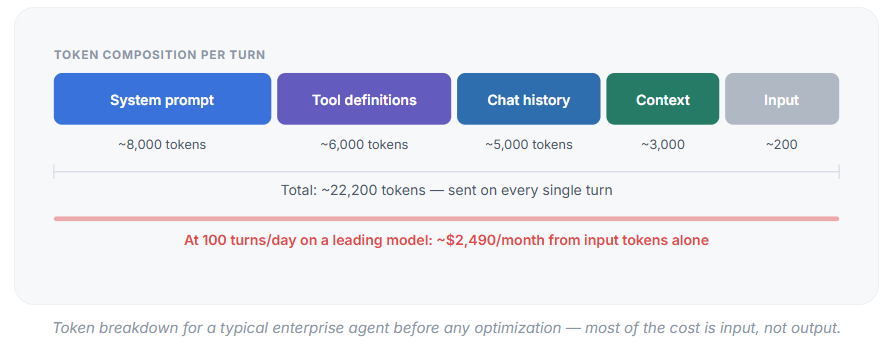
Input tokens are almost always cheaper than output tokens, but in agentic systems, input tokens are where the real cost hides. Agents do not just send one message — they send the full conversation history, system instructions, all tool definitions, retrieved context, and the user's latest input on every single turn.
The Four Root Causes — And How to Fix Them
Sending the Same Tokens Over and Over
The most expensive mistake in agentic AI is repeatedly paying to process the same information. Your system prompt might be 8,000 to 20,000 tokens long. Every time the agent responds, the model processes that entire prompt again from scratch. If the agent handles 500 conversations today, you pay for that system prompt 500 times.
The fix: prompt caching. Modern providers let you mark stable parts of a prompt so the model stores the computed result and reuses it — instead of reprocessing. Cached input tokens are billed at 80 to 90% less than regular input tokens. Stable content must go first; dynamic content last. One timestamp in the wrong place breaks the cache match and you pay full price again. Getting this right cuts input token costs by 60 to 80%.

Loading Every Tool on Every Turn
A capable enterprise agent typically has 20 to 40 available tools: database queries, calendar lookups, CRM reads, API calls, and more. Each tool definition can be 200 to 500 tokens. Most agents load all of them into every message — even when only 2 or 3 are relevant to the current task.
The fix: lazy-loading tools. A lightweight routing step — using a smaller, cheaper model — reads the user's message and returns only the relevant tool subset. The main agent gets a focused, lean context. This reduces tool-definition overhead by 40 to 70% depending on the size of your tool library.

3. Using One Model for Everything
Not every step in an agentic workflow requires the same level of intelligence. Most agents default to sending every task — from simple intent classification to complex multi-step reasoning — to the most capable and most expensive model in the stack. This is the equivalent of hiring a senior engineer to sort your inbox.
The fix: model routing and cascading. A smaller, faster, cheaper model handles routine tasks: intent detection, simple Q&A, structured extraction, short summaries. The large model is reserved for tasks that genuinely need it. Routing to smaller models where appropriate typically reduces per-conversation cost by 30 to 60% with no meaningful quality degradation.

4. Letting the Context Window Grow Without Bound
The longer a conversation goes, the more expensive each turn becomes. Most agents carry the full conversation history in every message. By turn 20, the agent is sending 19 full exchanges of prior history alongside the new message. Cost scales linearly with conversation length — and nobody budgets for this during testing because test conversations are short.
The fix: context compaction and selective retrieval. Periodically summarize older turns into a compressed version, replacing the raw transcript. Or store history in a vector database and retrieve only what is relevant to the current turn. Together these techniques reduce context-related costs by 50 to 80% in long-running or multi-session agent workflows.
Combined Impact: What Optimization Actually Looks Like
These four techniques are not independent. Applied together on the same agent and workload, the savings compound significantly. Here is what a realistic enterprise agent looks like before and after systematic architectural optimization.

Before You Optimize: What to Measure
None of these optimizations can be applied effectively without observability. Before you can reduce costs, you need to know where the tokens are actually going. Most major model providers surface this data in their API responses — if your team is not logging and reviewing it, you are flying blind on the single most controllable cost driver in your AI stack.
Average input token count per turn. This reveals whether your prompt structure is lean or bloated. Most teams are surprised when they first measure this number against what they expected.
Cache hit rate. If you have caching enabled but your hit rate is below 70%, your prompt structure is breaking the cache match. Find what is changing between turns that should not be.
Tool definition token overhead. If tool definitions exceed 30% of your average input token count, lazy-loading is your fastest win.
Model routing distribution. In most enterprise agents, 40 to 60% of turns could be handled by a smaller model without any quality degradation.
Context window size over conversation length. Plot this curve. If it grows linearly with no floor, you have no compaction in place and costs are scaling with every single turn.
Curious how your agent architecture holds up? Explore what TriSeed is building at the intersection of agentic AI and enterprise infrastructure and see how we approach cost-efficient deployment from day one.
At TriSeed, we build on Claude by Anthropic. We were selected as one of approximately 100 founding members of the Anthropic Claude Partner Network, chosen from more than 40,000 applicants globally. If your organization is planning an agentic AI deployment or is already running an agent that is consuming more budget than expected, we can help you identify where the cost is coming from and design the right architectural response.
Visit triseed.co to learn more!
Comments