
MCP vs API: What's the Difference, and When Is MCP Worth It?


If you have heard your tech team mention MCP, a fair first reaction is: "We already have APIs. Why do we need something new?" It is one of the most common questions about MCP, and most answers online are written for developers.
This guide covers MCP vs API for the people who make the decisions: what each one does, how they differ, and why the real answer is not "one or the other."
The short answer
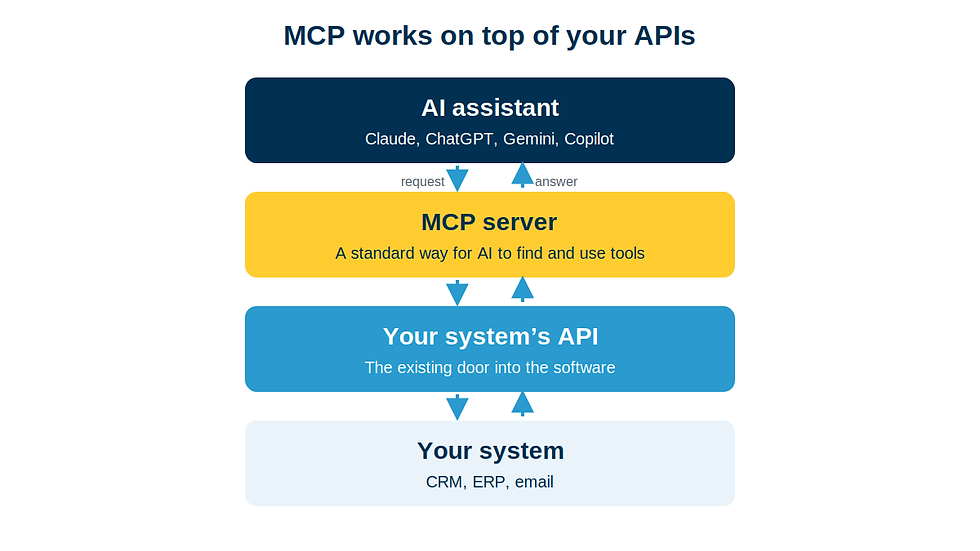
MCP does not replace APIs. An API is how one piece of software talks to another. MCP (Model Context Protocol) is a standard way for AI assistants like Claude and ChatGPT to discover and use tools and data. As Codecademy puts it, MCP "builds on top of" APIs: the APIs keep doing the work, and MCP makes them accessible to AI.
What is an API?
An API (application programming interface) is the door a piece of software opens so other programs can request information or trigger actions. Your CRM, your ERP, and your email platform almost certainly have one.
Each API is designed by its own vendor, with its own rules. A developer reads the documentation and writes code for that specific API. Connect five systems and you write five separate integrations.
What is MCP?
MCP is an open standard, introduced by Anthropic in November 2024 and now governed by the Agentic AI Foundation under the Linux Foundation, for connecting AI applications to external systems (modelcontextprotocol.io; Anthropic, Dec 9, 2025). Instead of every AI app learning every vendor's API, each system gets one MCP server, and any AI app that supports MCP can use it. New to the term? Start with our guide: What Is MCP in AI?.
MCP vs API: the key differences
Here is how they compare on the points that matter to a business:
Point | API | MCP |
Who it is built for | Developers writing code | AI assistants and the apps they run in |
How the connection works | Each integration is planned and coded ahead of time for one specific API | The AI app asks the MCP server what it can do, and the server lists its tools at that moment. The MCP docs note this lets the list change over time. |
Standard | Every vendor designs its own | One shared protocol for every MCP server |
Reuse | One integration per app and per system | One MCP server can serve any MCP-compatible app, including Claude, ChatGPT, Gemini, Microsoft Copilot, VS Code, and Cursor |
What it exposes | Endpoints and data formats | Tools (actions), resources (information), and prompts (ready-made instructions) |

Is MCP just an API wrapper?
It is a fair question, and the honest answer is: often, yes, technically. Many MCP servers take an existing API and wrap it. What the wrapper adds is the value: a shared standard every major AI app understands, a way for the AI to ask what tools exist instead of a developer hard-coding each one, and one connector that works across Claude, ChatGPT, Gemini, and Copilot instead of one integration per app.
If you only ever need one fixed integration that no AI will touch, that wrapper adds little. If you want AI assistants working across several of your systems, it saves rebuilding the same connection again and again.
Will MCP replace APIs?
No. MCP needs something to connect to, and in most businesses that is an existing API. Think of the API as the door and MCP as the standard way an AI assistant knocks, asks what is inside, and uses it. Your APIs keep doing the work. MCP makes them usable by AI without a custom build for every assistant.
Is MCP more secure than an API?
Neither is automatically more secure. Security depends on how each is set up. MCP does add new things to think about, because an AI is now choosing which actions to take. The official MCP security guidance covers risks such as the "confused deputy" problem (a server acting with more authority than the person asking should have) and token passthrough, and it recommends scope minimization: giving each connection only the access it needs (Model Context Protocol, "Security Best Practices").
In business terms, before connecting an AI to a system through MCP, decide:
What data each MCP server can reach.
Which actions the AI can take on its own and which need a person to approve.
Whether the AI respects each user's existing permissions, so people only see what they already could.
Our engineering team covers this in depth in Why a Valid Token Is Not Enough.
Is an MCP server like an API gateway?
Not quite. An API gateway manages traffic to APIs and microservices for applications. An MCP server presents a system's capabilities to AI apps as tools, resources, and prompts. They work at different layers, and they can work together, with an MCP server calling APIs that sit behind a gateway.
A newer piece is the MCP gateway, which sits in front of MCP servers to control which tools each AI agent is allowed to use. Traefik Labs describes API gateways, AI gateways, and MCP gateways as separate layers that larger companies may need together (Traefik Labs, "API Gateway vs AI Gateway vs MCP Gateway").
How do you turn an API into MCP?
You build an MCP server for it. The server takes the actions your API already supports, such as "look up an order" or "create a ticket", and describes them as tools an AI can understand and call. The MCP project publishes official SDKs in several programming languages to do this.
Beyond the build, decide which actions to expose, what the AI is allowed to change, and how access is controlled.

Why use MCP instead of an API? And when is an API enough?
An API alone is enough when one system needs to talk to another in a fixed, predictable way, like syncing orders between your store and your ERP every night.
MCP makes sense when you want an AI assistant to work with that system on request, like answering "which orders from this week are late?" or drafting a follow-up to a customer, and you want that connection to work across more than one AI app.
In practice the two work together: APIs keep doing the actual work, and MCP adds a standard layer that makes them accessible to AI (Codecademy).
Is MCP dead? The 2026 debate, in plain terms
If you have seen "MCP is dead" posts this year, here is one real issue behind them: connecting an AI to many tools at once can fill up its working memory before it starts on the task. Anthropic's own engineering team has written about this, noting that tool definitions can overload the AI's context window, and has published ways to reduce it (Anthropic Engineering, "Code execution with MCP," Nov 4, 2025).
At the same time, MCP is now run by an industry foundation under the Linux Foundation, co-founded by Anthropic, Block, and OpenAI, and it is supported in ChatGPT, Gemini, Microsoft Copilot, Cursor, and Visual Studio Code (Anthropic, Dec 9, 2025). For a business, the useful question is not whether MCP is trendy. It is whether your AI needs controlled, reusable access to your systems. If it does, MCP is the standard the major AI platforms have adopted for exactly that.
How TriSeed approaches MCP and APIs
For a wholesale distribution client, TriSeed built and secured a remote MCP server so Claude could work with the client's own business data in production. The work was not only connecting systems. It was deciding what Claude could see, what it could do, and making sure access followed each user's permissions.
As a Claude Partner Network Certified Services Partner, TriSeed's Claude Certified Architects and Forward Deployed Engineers help teams decide where MCP fits on top of the APIs they already have.
Already have APIs and wondering
where AI fits?
TriSeed builds and secures MCP servers on top of the APIs you already have, so Claude can work with your real business data.


Comments