
Top vLLM Alternatives in 2025: Faster, Cheaper, and More Flexible LLM Serving Options


Deploying large language models is no longer only about choosing the best model. The real performance gains happen at the inference layer, where engines like vLLM deliver speed, lower latency, and efficient GPU utilization. But in 2025, vLLM is no longer the only strong contender. Businesses are now exploring powerful vLLM alternatives that offer lower cost, broader hardware support, and better deployment flexibility across cloud, edge, and on-premises environments.
This guide breaks down the best vLLM alternatives today, when to use them, and how they perform in real-world scenarios.
What Is vLLM and Why Consider Alternatives?
vLLM is one of the fastest open-source LLM serving engines available, using features like PagedAttention to maximize GPU throughput. It is ideal for applications that require high concurrency, long context windows, and real-time responses.
However, vLLM is not always the best fit. It performs best on powerful GPUs, offers limited advantages for CPU-only environments, and may be too heavy for edge or low-resource deployments. These gaps are pushing teams to evaluate alternatives that better align with their infrastructure, budget, and deployment strategy.
Best vLLM Alternatives in 2025
Below are the top 5 vLLM alternatives, each chosen based on real-world performance, hardware flexibility, and deployment scenarios.

Best for: Flexible deployment and broad hardware support
TGI is widely used in production AI systems, supporting an extensive range of models, GPUs, CPUs, and multi-cloud environments. It is the top choice for teams that need reliable APIs, easy model switching, and strong compatibility with Hugging Face tools.
Why choose TGI:
Works with more hardware types
Simple, OpenAI-compatible API
Strong community and enterprise ecosystem
2. llama.cpp

Best for: CPU, mobile, and edge deployment
llama.cpp excels in environments where GPUs are not available. It is optimized for on-device inference and offline workloads, making it perfect for lightweight AI applications.
Why choose llama.cpp:
Runs efficiently on CPUs
Excellent portability
Supports many quantization formats
3. TensorRT-LLM

Best for: Maximum NVIDIA GPU performance
This framework is designed by NVIDIA to achieve the absolute highest performance on their hardware. It is ideal for real-time AI systems or applications with extremely high throughput requirements.
Why choose TensorRT-LLM:
Superior latency and throughput
Deep hardware-level optimizations
Strong support for quantization and large models
4. MLC LLM

Best for: Cross-device, compiler-driven portability
MLC LLM enables LLMs to run anywhere: server, laptop, iOS, Android, smart TVs, or the browser. It is the most versatile option for teams building on-device or cross-platform AI applications.
Why choose MLC LLM:
Broadest device compatibility
Efficient on-device inference
Supports CUDA, Metal, Vulkan, and WebGPU
5. SGLang
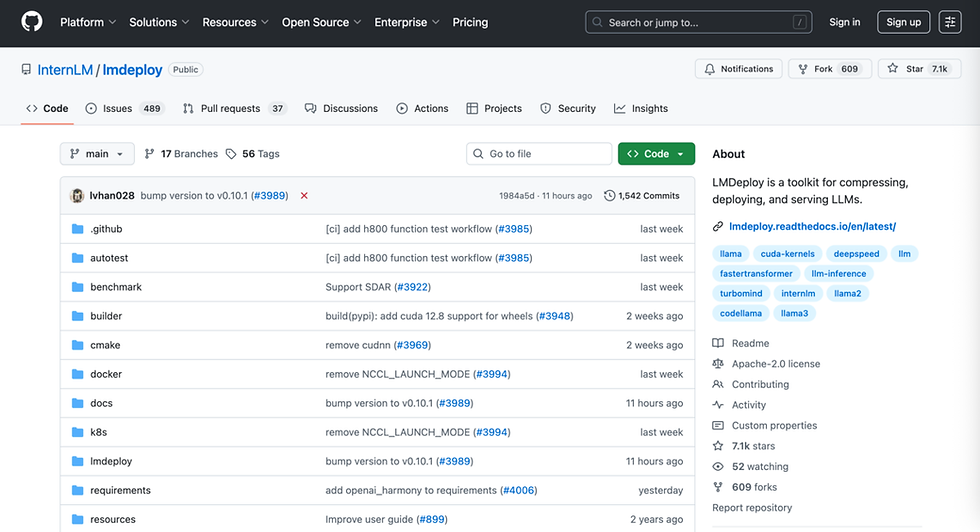
Best for: Next-generation model optimization
These modern frameworks are optimized for the latest LLM architectures. They offer competitive performance with lightweight runtimes and support for aggressive quantization.
Why choose them:
Fast for new models like Llama 3, Mixtral, and Qwen
Cleaner setup with smaller runtimes
Strong performance vs vLLM in many benchmarks
How to Choose the Right LLM Serving Engine
Use the table below to quickly identify which tool fits your environment, budget, and performance requirements:
Decision Factor | Best Choice | Why This Option Fits |
Strong NVIDIA GPU resources | vLLM or TensorRT-LLM | Highest throughput and lowest latency on GPU-heavy setups. |
Broad hardware flexibility | Hugging Face TGI | Works well across CPU, GPU, and many cloud platforms. |
Offline, mobile, or edge use cases | llama.cpp or MLC LLM | Optimized for low-resource, on-device deployment. |
Deploying latest-gen models | SGLang | Built for modern architectures like Llama 3 and Mixtral. |
Simplest setup and API integration | TGI or vLLM | Easy-to-use, OpenAI-compatible endpoints. |
Cost-sensitive environments | llama.cpp, MLC LLM, or TGI (CPU) | Reduces infrastructure cost using CPU or aggressive quantization. |
Need maximum speed at all costs | TensorRT-LLM | NVIDIA-optimized for best-in-class performance. |
Make the Right Choice for Your AI Infrastructure
Choosing the right LLM inference engine is a strategic decision that affects performance, cost, and deployment speed. With so many strong alternatives to vLLM, businesses can reduce GPU usage, expand hardware compatibility, and build more scalable AI applications. The right choice depends on your infrastructure, model requirements, and long-term AI roadmap.
The AI landscape is moving fast, and the companies who act now will be the first to capture real competitive advantage. If you need help evaluating vLLM alternatives or want to deploy high-performance AI systems without delays, TriSeed can guide you from architecture design to full-scale implementation.
Don’t wait until your competitors move ahead. Talk to TriSeed today and accelerate your AI deployment now. Visit us at https://www.triseed.co/


Comments