
What Is a Forward Deployed Engineer, and Why Does It Matter for AI Right Now?

Updated: 6 days ago

Building a working AI product used to take a team, weeks of engineering time, and a real budget. Coding agents have collapsed that timeline. They can scaffold a full application, wire up a model, and ship something that looks and functions like a real product in a single sitting.
That is genuinely useful. It is also a problem, if your business is built on selling AI software.
The Moat Problem
For years, software companies built their advantage on being hard to replicate. Complex logic, years of engineering, a head start nobody could catch up to quickly. AI coding tools have quietly erased a lot of that advantage. If a competitor can describe what your product does, there is a real chance they can build a working version of it in days, not years.
This does not mean software has stopped mattering. It means software alone is no longer enough of a moat on its own. The companies pulling ahead are the ones building something that cannot be replicated by describing it to a coding agent, because part of what they are building lives outside the software entirely.
What a Forward Deployed Engineer Actually Does
A Forward Deployed Engineer, or FDE, is not a support role and not a typical implementation consultant. The term describes an engineer who works embedded with a client, building directly against that client's real systems, real data, and real physical environment, instead of shipping a generic product and hoping it fits.
The model itself is not new. It became well known through companies like Palantir, where engineers were placed directly inside client organizations to build and adapt software against messy, specific, real-world conditions that a one-size-fits-all product could never handle well.
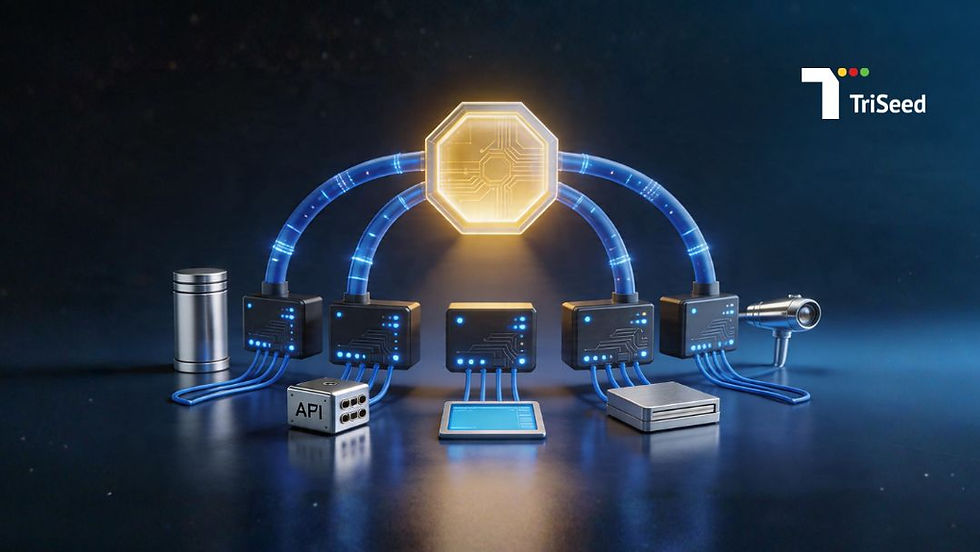
What has changed is the AI layer on top of it. A Forward Deployed Engineer working with modern AI models is not just customizing a dashboard. They are building agents and workflows that read a client's actual operational data, connect to a client's actual systems, and in a growing number of cases, connect to the client's actual physical hardware.
That last part is where the real moat is forming.

Why Hardware Changes the Difficulty
Software-only AI is comparatively easy to copy because everything happens inside a browser or a server. Hardware-integrated AI is a different kind of problem entirely.
Physical devices have firmware constraints, connectivity limits, safety requirements, and inconsistent data formats that vary by manufacturer and even by device generation. Getting an AI agent to reliably read data from a piece of equipment, act on it correctly, and fail safely when something goes wrong requires understanding both the software and the physical system it is touching. That combination of skills is far rarer than pure software engineering, and there is no shortcut around actually learning the hardware.
This is the actual moat. Not the AI model itself, since most companies now have access to comparable models. The moat is the ability to make that model work reliably against a physical, imperfect, real-world system.
What This Looks Like in Practice
This pattern shows up across industries. A logistics fleet needs AI that can read camera feeds and sensor data from moving vehicles in unpredictable road conditions, not just process a spreadsheet of planned routes. A manufacturing floor needs AI that can interpret real-time signals from machinery and flag an anomaly before it turns into downtime, not just analyze a production report after the fact. A healthcare provider needs AI that can work with data captured through actual medical devices, where the format and reliability of that data is decided by the hardware, not by the software team.
In each case, the software is only half the problem. The other half is making it work against a physical system that was never designed with AI in mind.

Where TriSeed Fits
TriSeed is a member of Anthropic's Claude Partner Network, and builds enterprise AI applications on Claude. That credential is a starting point, not the whole story. What matters more is how that capability gets deployed: embedded with a client's real systems, built around their actual operational constraints, extending into hardware where the use case calls for it.
That is the practical definition of Forward Deployed Engineering as TriSeed applies it. Not a generic AI product handed off with a support contract, but engineers who work directly against a client's real environment, software and hardware both, until the system actually works the way the business needs it to. See what that looks like across TriSeed's own projects.
Talk Through What This Looks Like for You
If your team is weighing how to make AI work against real, physical operations rather than just a dashboard, that is exactly the kind of problem Forward Deployed Engineering is built for. Worth a conversation before the project gets scoped.
FAQ
Is a Forward Deployed Engineer the same as a solutions engineer or implementation consultant? Not quite. Traditional implementation roles typically configure an existing product to fit a client. Forward Deployed Engineering usually means building custom, often novel solutions directly against a client's specific systems, which can include physical hardware integration that a standard product was never designed to handle.
Does this only apply to companies with physical products? No. The FDE model applies to any situation where AI needs to work against complex, non-standardized, real-world systems, which includes plenty of pure software environments too. Hardware integration is simply one of the clearest examples of why the model matters, because it is one of the hardest things to fake or shortcut.
How do I know if my company actually needs this, versus a standard AI product? If an off-the-shelf tool already solves your problem well, you probably do not need it. The signal to look for is friction: your AI needs data or access that only exists inside a physical system, a proprietary format, or a workflow no vendor built for, and a generic product keeps falling short of that gap.


Comments