
Multi-Agent Orchestration: The Architecture Enterprise AI Actually Needs

Why Single-Agent Systems Break Under Enterprise Load
Build a single agent and ask it to handle an enterprise workflow end to end. It will work in your test environment. It will probably work in your staging environment. And then, somewhere between the first hundred production transactions and the first unexpected edge case, it will fail in a way that is difficult to diagnose, harder to reproduce, and expensive to fix.
This is not a model quality problem. It is an architectural problem, and it has a straightforward solution: distribute the work.
What Multi-Agent Orchestration Actually Means
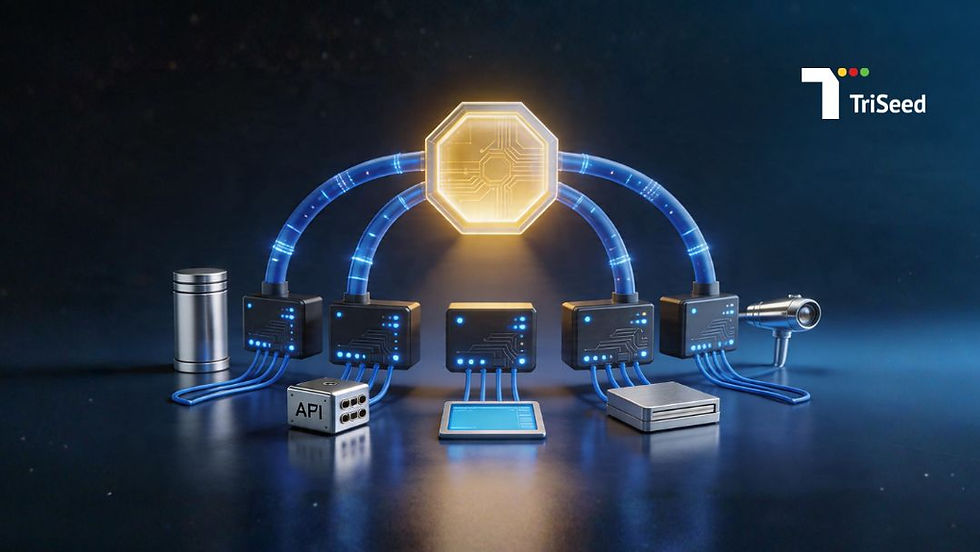
Multi-agent orchestration is the practice of coordinating multiple specialized AI agents to complete a workflow that no single agent should handle alone. Each agent in the system has a defined role, a limited scope, and a set of tools it is authorized to use. An orchestrator agent manages the overall workflow, assigns tasks to specialized agents, and handles the results.
The key word is "specialized." A research agent should not also be a writing agent or a data retrieval agent. Specialization reduces prompt complexity, makes each agent's behavior more predictable, and makes the overall system easier to test and monitor independently. When something fails, you know exactly which agent is responsible and why.
The Orchestration Patterns That Work in Production
After building multi-agent systems that run in production environments, several patterns have proven consistently reliable. The supervisor pattern places a dedicated orchestrator agent at the top of the hierarchy. The orchestrator does not execute tasks; it routes them, monitors their status, and handles failures by retrying or escalating. This separation of orchestration from execution is the most important design decision in a production multi-agent system.
The tool access pattern is equally important. Each agent should have access only to the tools it needs for its specific role. Using a protocol like Model Context Protocol (MCP) enforces this boundary at the connection layer, not just in the prompt. FastMCP, the lightweight implementation framework, makes this practical for production deployments without heavy infrastructure overhead.
Idempotency must be built into every tool call. In a production system, an agent may execute the same action twice due to retries or orchestration restarts. If a tool call is not idempotent, the retry produces a different result than the original, which creates data inconsistency and debugging complexity. Designing for idempotency from the start eliminates an entire class of production bugs.
The Data Platform Connection
Multi-agent orchestration and enterprise data infrastructure are not separate conversations. The reliability of a multi-agent system depends directly on the quality of the data it works with. An orchestrated system of ten well-designed agents working on unreliable data produces unreliable outputs with higher confidence and at higher speed than a single agent making the same mistakes.
This is why at TriSeed we build orchestration on top of Databricks. Unity Catalog ensures that every dataset an agent can access has defined ownership, lineage, and access controls. Delta Lake ensures that the data is versioned and consistent. Mosaic AI ensures that the models behind the agents are deployed from the same governed environment as the data they consume. The architecture is coherent, not stitched together.
Measuring Whether Your Orchestration Is Working
A production multi-agent system should be observable in real time. The minimum instrumentation layer should capture: which orchestrator routed which task to which agent; how long each agent task took; whether each tool call succeeded or failed and why; and what the final output of each agent was before passing to the next stage.
This observability layer is not just an operational convenience. For enterprises in regulated industries, it is the audit trail that allows compliance teams to answer examiner questions about automated decision processes. Building it from the start is significantly cheaper than retrofitting it after a compliance question surfaces.
TriSeed designs and builds multi-agent orchestration systems for enterprise clients on Databricks and AWS. If you're designing your AI architecture and want a review from a team that has built these systems in production, visit triseed.co or message us directly.


Comments